SESSION 1 - 1 AIA CEU Credit / 1 Phius CEU
From BIM to Low Carbon Manufacturing:
Why Architects Must Think in Parts
August 26th - 12:00 pm to 1:00 pm EST
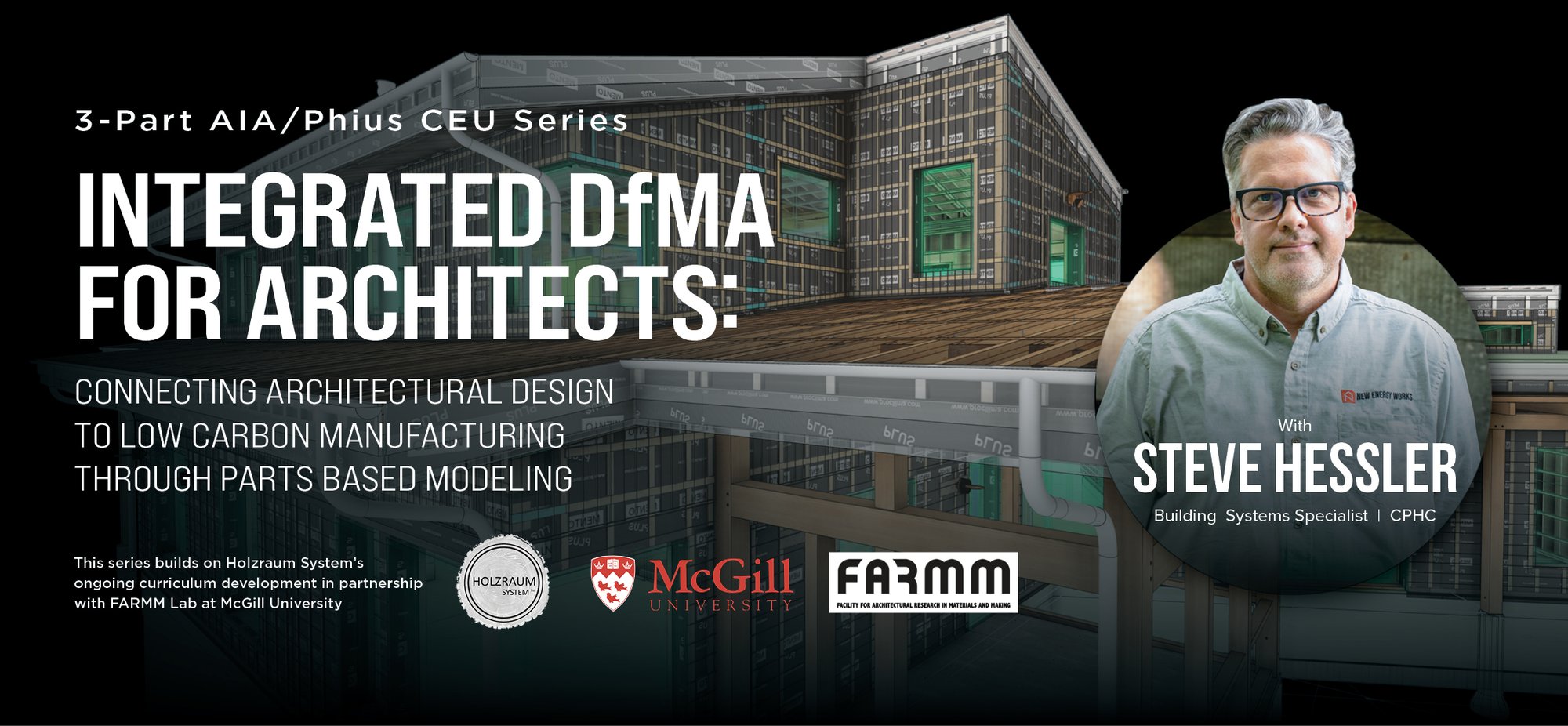
This course introduces Integrated Design for Manufacture and Assembly (IDfMA) as an expanded framework that connects architectural modeling to offsite manufacturing workflows. Participants will explore how parts-based modeling—rather than traditional object-based BIM—enables the integration of structure, thermal performance, and water and vapor management into fabrication-ready systems. Using real-world examples from panelized timber and high-performance enclosure projects, including a Phius Design Certified passive building utilizing foam-free, vapor-open, light-frame enclosure panels, the session demonstrates how architects can begin engaging manufacturing logic using their existing modeling platforms.
Learning Objectives
By the end of this session, participants will be able to:
Explain the evolution of DfMA and why construction requires an expanded, integrated approach.
Differentiate between traditional BIM object modeling and parts-based manufacturing modeling.
Identify how structural, thermal, and hygrothermal systems can be embedded directly into architectural models and translated into foam-free, vapor-open, high-performance enclosure systems.
Examine a Phius Design Certified passive building case study to understand how parts-based modeling and offsite manufacturing can support the delivery of light-frame, panelized enclosure assemblies.
SESSION 2 - 1 AIA CEU Credit / 1 Phius CEU
The IDfMA Roadmap:
From Concept Design to GR3 Fabrication Review
September 2nd - 12:00 pm to 1:00 pm EST
This session introduces a structured, phase-based IDfMA roadmap that integrates architectural design, engineering, and fabrication modeling from SD, DD, and CD through manufacturing and assembly. Participants will explore how geometry review gates (GR1, GR2, and GR3) create binding alignment between architects, engineers, and manufacturers while maintaining design intent and performance goals. A Phius Design Certified passive building case study featuring a hybrid mass timber structure and light-framed, vapor-open enclosure panels will demonstrate how this coordinated workflow can be applied to a complex, high-performance building project.
Learning Objectives
By the end of this session, participants will be able to:
Describe a phased IDfMA workflow from schematic design through fabrication.
Understand how geometry review milestones reduce risk and improve coordination.
Identify where architects can embed structural and enclosure logic early in design, including the integration of mass timber and light-framed, vapor-open panel systems.
Apply a simplified IDfMA roadmap to their own practice workflows using lessons from a Phius Design Certified hybrid mass timber case study.
SESSION 3 - 1 AIA CEU Credit / 1 Phius CEU
Low-Carbon Outcomes:
Vapor-Open Systems, Carbon Accounting
& Circular Design Through IDfMA
September 9th - 12:00 pm to 1:00 pm EST
This session explores how Integrated DfMA enables scalable, low-carbon construction through vapor-open assemblies, biogenic materials, and circular design principles. Participants will examine how parts-based modeling supports hygrothermal performance, carbon tracking, and future deconstruction planning—positioning architects at the forefront of industrialized, low-carbon design. Through a comparative examination of two Phius Passive Building case studies—one utilizing a hybrid mass timber structure with light-framed, vapor-open enclosure panels and the other utilizing a fully light-frame panelized enclosure system, the session will identify opportunities for advancing circular design and manufacturing workflows.
Learning Objectives
By the end of this session, participants will be able to:
Explain how vapor-open assemblies function differently from vapor-closed control-layer systems.
Identify how parts-based modeling improves hygrothermal resilience across hybrid mass timber and light-frame panelized building systems.
Understand how IDfMA supports embodied carbon accounting, EPD integration, and comparative evaluation of structural and enclosure approaches.
Recognize how designing for disassembly and future material recovery can be embedded into manufacturing workflows by examining opportunities within two Phius-certified passive building case studies.